5 mins
January 23, 2026
How to Break Phone Addiction: 7 Steps That Actually Help
Constant scrolling is built to be hard to stop. Seven practical steps to cut screen time and get your attention back, without deleting everything.

Share

Subscribe
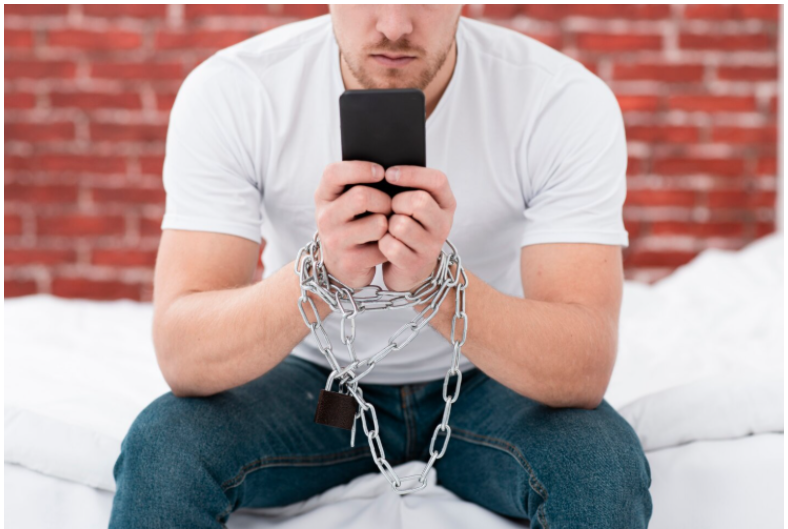
"I keep telling myself I’ll stop scrolling… and then suddenly it’s 2 AM. I don’t even remember what I was looking at."
If that sounds familiar, welcome! Not in a judgmental way, but in the finally-you’re-not-alone way.
People today aren’t addicted to their phones because they’re weak, lazy, or dramatic. They’re addicted because their phones are designed to keep them hooked. The constant buzzing, the endless scrolling, the pressure to stay “online” and updated with trends… It’s quietly draining us.
Studies show that average users check their phones 85–150 times a day, without realizing their hands even move.
If you’re worried about how can I stop being so addicted to my phone? Just know that more people wake up already exhausted. Not from work, not from life stress, but your phones are sucking your energy.
If that sounds familiar, this guide is for you.
The first thing you need to do to overcome an addiction is to realize you have one.
Try this: lie down on your bed without your phone. Ask yourself simple questions:
Your answer must be almost always no. When you really look at it, most of what we do on our phones doesn’t add much to our lives. People lived well before smartphones existed.
I was once stuck in that same cycle, so I tried this myself. I spent time just thinking about how my phone could slowly ruin my future. That made me wonder: ‘Do I even need a smartphone?’
And honestly, for me, the answer was no. It wasn’t helping me. It was hurting my health, my focus, my time and my money too.
Phone addiction (or “problematic smartphone use”) has been researched for years, and psychologists say it impacts:
Kostadin Kushlev, a Georgetown psychology researcher, explained it perfectly:
“Phones can have small, often hidden, costs for well-being that can nonetheless add up over time.”
These “small costs” are exactly why your phone feels heavier than it looks. Here are powerful signs your phone is controlling more than you realize:
You feel your phone vibrate, but it didn’t. Your brain has become trained to anticipate notifications, even when none exist.
You open an app for a “quick check”… 30 minutes later, you’re still scrolling but can’t recall what you saw.
This is classic dopamine depletion, where your brain keeps searching for a hit that never truly satisfies.
FOMO (Fear Of Missing Out). Your phone keeps your brain in constant comparison mode. You’re always catching up, never enough, never good enough. But the moment you unplug, you taste JOMO (Joy of Missing Out): Peace. Presence. Quiet.
You know it’s ruining your sleep. But that “one last check” pulls you into another 25 minutes of reels or scrolling.
Clinical studies say phone use before bed acts like “artificial daylight,” tricking your brain into staying awake. If you're experiencing burnout or creeping exhaustion, your mobile habits could be playing a bigger role than you think.
Think about smoking for a moment. One reason it hooks people is the steady stream of small dopamine boosts. Smartphones work in a very similar way, as they’re more convenient to carry around. They’re always with us, always within reach, and always ready to satisfy our nerves.
You can use a computer or a laptop for the same purpose, but you can’t carry a laptop in your pocket everywhere you go. And even if you did, you wouldn’t casually pull it out every few minutes to check notifications or social media.
Phones are built for instant pleasure. One tap, one swipe, one notification — and your brain lights up.
Focus on what you’re doing on your phone:
These things matter, but many people overlook the context. Even something enjoyable or harmless, like gaming, can have a downside if it takes up too much space in your life.
For example, if you’re spending five hours a day on gaming or Instagram reels, then you’re not doing other things.
More screen time means:
Phones can hurt your happiness. The more time you spend glued to a screen, the less time you spend resting or connecting with people, which causes your well-being to take a hit.
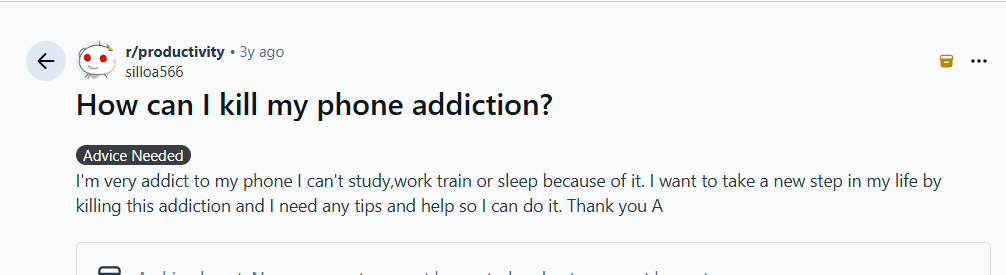
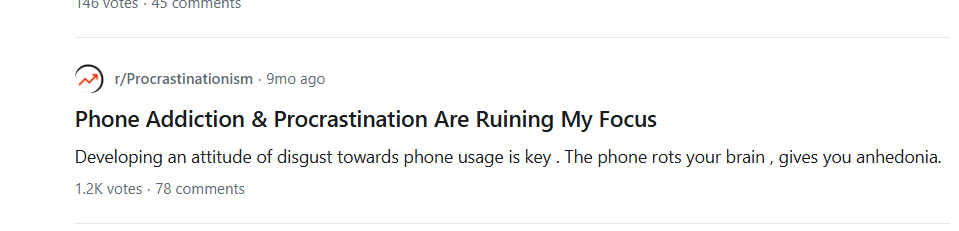
So the problem isn't just what you’re doing on your phone, it’s what your phone is replacing. On Reddit, people are anxious about similar issues.
Please add here the attached screenshots as a gallery that I pasted with links at the end of the Blog.
Have you ever told yourself, "Just five more minutes," and then looked up an hour later? You’re not weak-willed—the system is built to make you do that.
Addiction Expert, Dr Anna Lembke, reveals just how addictive our phones are.
“These devices and platforms were designed to be addictive, that is, to keep us scrolling and tapping long beyond what we plan for or what we want. It is a drug.”
Think about it like a slot machine in your pocket. Every time you check, you don’t know if you’ll see a like, a funny video, or a new message. That “maybe I’ll get something good” feeling hooks you. It’s not an accident. Companies design apps to give you small rewards at random times, because that’s what keeps people coming back the most.
Steve Bartlett, the writer of “The Diary of A CEO”, warns:
“Smartphones hijack dopamine systems, leading to misuse, poor focus, and a lack of real-world connection, especially with parents and children.
"Dopamine" is a brain chemical linked to pleasure and motivation. Your phone provides a constant, easy stream of it. Why have a deep talk with a friend when you can get a quick laugh from a reel?
With time, real-life things—like finishing a project or having a conversation start to feel less rewarding. This isn’t a mere distraction; it’s your brain’s reward system being tricked.
Tati Garcia, a licensed therapist and coach specializing in high-functioning anxiety, says:
“Phones themselves are not evil tools, but your addiction to this tiny device in your pocket is destroying your mental health”
Constant phone use is linked to higher feelings of anxiety, loneliness, and poor sleep. Here’s why:
The good news? You can take back control. It starts with small, smart changes.
If you’re thinking about making a big change, start by reducing your dependency step by step. Don’t rush—prepare yourself first.
Tati Garcia — a licensed therapist and coach known for her practical, mental health advice, shares simple habits that can help anyone break out of the endless scrolling cycle.
Here are her tips:
1. Be intentional, not passive.
Rather than becoming an unintentional consumer of whatever comes on the screen, being more intentional about what you want to be influenced by will help. Curate your online world the same way you curate your real life.
2. Follow only the accounts that make you feel good.
Clear out negativity. Keep creators who inspire you, calm you, or genuinely add value.
A healthier feed = a healthier mind.
3. Give your phone boundaries.
You don’t need superhuman willpower — you just need distance.
4. Practice mini-disconnection daily.
Give yourself at least one hour away from your phone. Use that time to be present — talk to people, cook, walk, breathe. You can also join online support communities designed for emotional wellness, like MentalHappy, to reconnect in healthier ways. This short intentional break helps reset your brain from constant stimulation.
5. Make distractions harder to reach.
Move addictive apps to a hidden folder, or switch your screen to greyscale when you feel tempted to scroll. Changing your environment changes your habits.
6. Create a Phone-Free Sanctuary
Make your bedroom, or at least your bed, a device-free zone.
If you need encouragement or want accountability while building healthier phone habits, communities like MentalHappy offer group support and guidance
No need to make your life devoid of activities. Replace your phone-checking habit with:
Your brain needs time to remember what enjoyment feels like without a glowing screen.
When you’re stuck, the best advice doesn’t always come from experts. It usually comes from people who’ve been trapped in the same struggle and managed to climb out of it.
Here are some powerful, real-life experiences that I collected from people who actually broke their phone addiction.
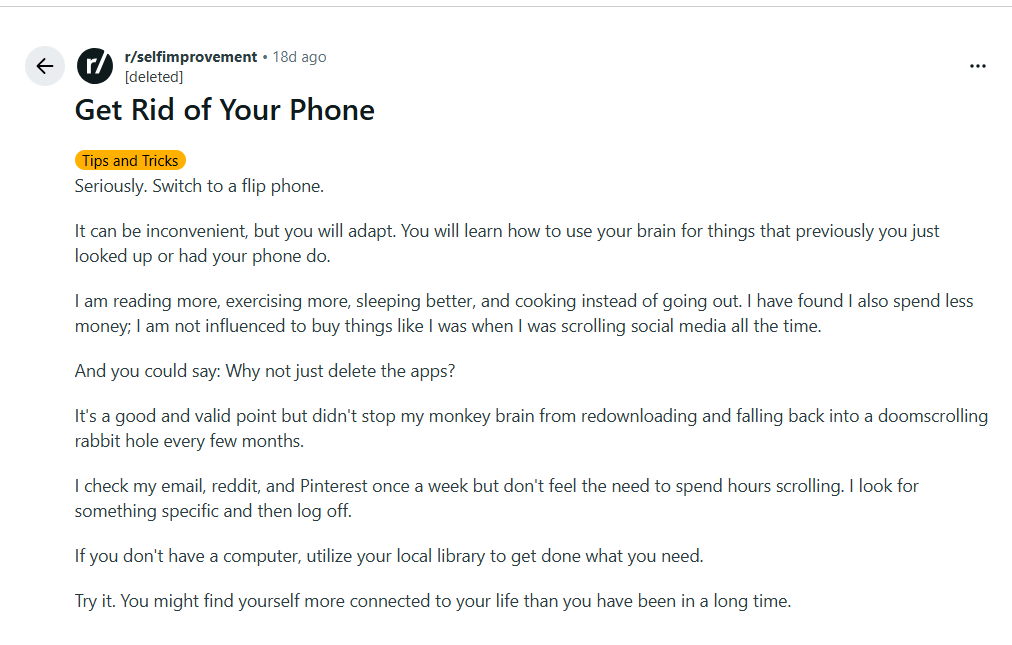
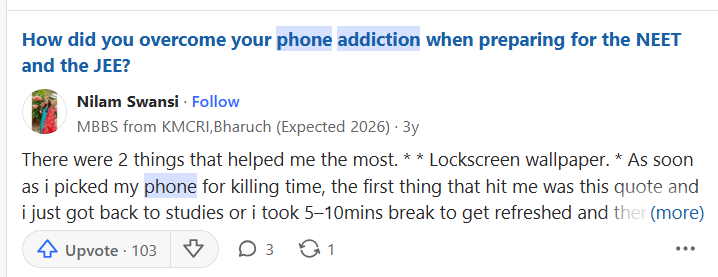
“Get rid of your phones completely and use an old phone or computer for work and communication” (Quora)
This person shares that, at first, it felt inconvenient. He couldn’t Google everything instantly. He couldn’t scroll when bored. But slowly, his brain adjusted.
The change forced him to use his brain again. He tried his best to remember directions, cooking without TikTok videos playing in the background, and even sitting with his own thoughts.
And the days changed:
His advice?
If you truly want to break the addiction, make your phone less powerful. And if you don’t have a computer? Use your library. Real-life tools still exist. We just forget about them.
“You might feel more connected to your life than you have in years.”
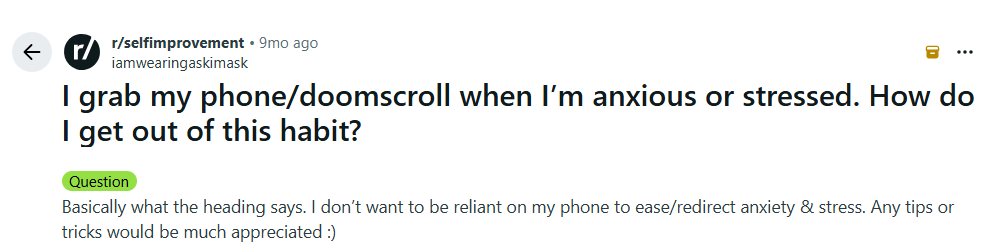
This Reddit user shared something bold:
“I thought deleting apps would help. But it didn’t stop my monkey brain from redownloading and falling back into a doomscrolling rabbit hole every few months. So I made my phone impossible to use for entertainment.”
How?
This simple friction cut his screen time dramatically. When something becomes less convenient, your brain stops craving it.
Try this:
This quote is best set as wallpaper:
“No matter how hard you work, someone else is working harder.” — Elon Musk)
Sometimes a tiny pause is all you need to break a habit.
First, let me tell you what did not work for me. I tried the common tips, all the people suggested around me, and they failed every time.
What Did Not Work:
I learned that the phone itself is not the problem. My daily habits were the problem.
What Worked for Me:
I charge my phone on a chair far from my bed. When I wake up, I can’t reach it right away. This stops me from scrolling first thing in the morning.
I stopped setting an alarm on my phone. Now I wake up with sunlight from the window. I check the time on a wall clock instead.
If your phone is on silent, you keep checking it to see if you missed something. If it’s on a ring, you only pick it up when it actually rings.
Even when my phone is far away, I still want to check it. I just tell myself: “First, eat breakfast. First, get ready.” Then the feeling goes away.
I made a promise with my partner: no phones in the bathroom. Now it’s a fun challenge. We remind each other to follow this rule.
One Sunday, I left my phone in the living room and forgot about it until the next day. It felt great! Now on weekends, I leave it in another room. If it rings, I answer. If not, I enjoy my day without it.
The real secret is not willpower for one big change. It is building small new habits, one at a time. Start with just one. You can take back your time and your attention.
Changing your phone habits isn’t about winning a battle with willpower. It’s about quietly rewiring your daily routines—one small step at a time. You don’t have to delete your apps or throw your phone away. Instead, try creating little gaps between you and the screen. Charge it outside your bedroom. Turn off the colorful display. Silence the nonstop notifications.
These simple acts will improve your sleep, your focus, your real-life connections, and your own quiet thoughts. This isn’t about living without technology. It’s about making your life peaceful, focused, and fully yours.
https://www.reddit.com/r/AskReddit/comments/1ktggrq/how_addicted_are_you_to_your_phone/


https://www.quora.com/search?q=phone%20addiction



.svg)


