I Was Never Loved: Healing From a Narcissistic and Abusive Parent
Feeling unloved growing up with an emotionally abusive parent? Learn how childhood trauma shapes adulthood and discover an expert’s opinion to heal, rebuild your personality, and break toxic family cycles.
“I was never loved to begin with. I grew up with a narcissistic psychopath of a father...”
It’s terrifying when you realize the person who should have loved you the most and protected you was the danger instead of the protector; the world stops feeling safe.
In many of the cases, Parents use manipulative language and abusive behaviours to take control of their children's lives. As a child (doesn’t matter if you are an adult), you may feel that there’s no way you can make them happy or get rid of them.
Growing up with a selfish or emotionally abusive parent leaves a wound that doesn’t disappear even when you turn 18. It shows up in your adulthood, in your relationships, in your self-worth, even in the way you talk to yourself.
“A child that is being abused by its parents doesn’t stop loving its parents. It stops loving itself.” – Shahida Arabi
That quote is painful. But it’s 100% true. If you grew up with a parent who never truly loved or supported you, that lack of love becomes a deep, invisible wound.
What It Means to Grow Up Feeling Unloved
To grow up feeling unloved by a parent isn’t about missing out on birthday parties or big gifts. It’s the feeling of being a ghost in your own home.
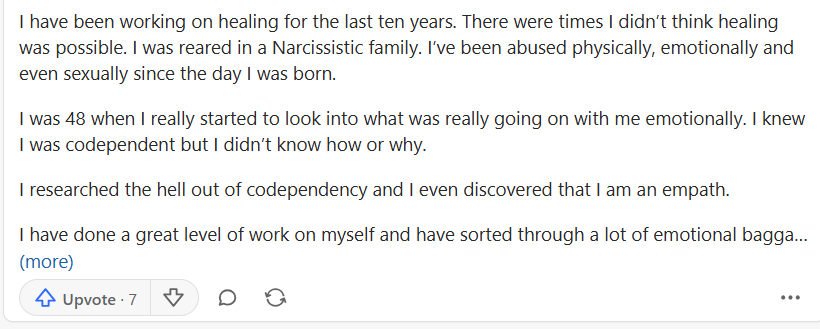
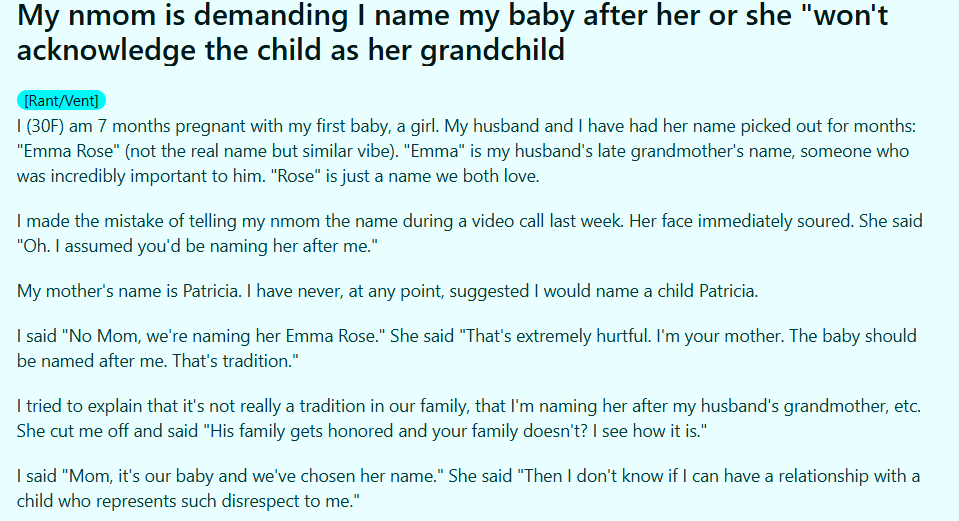
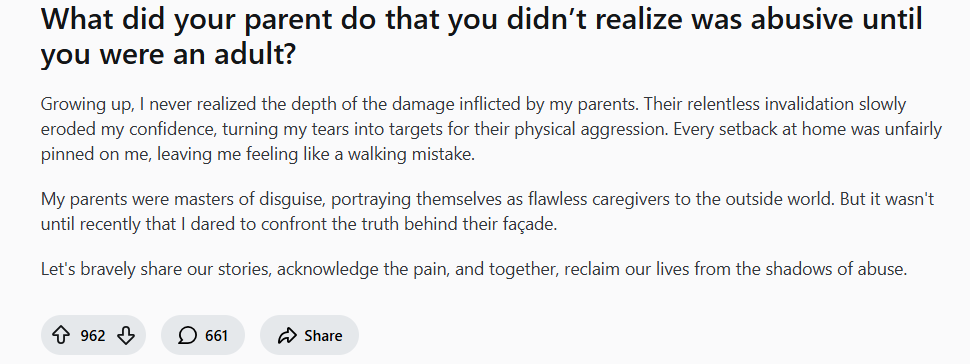
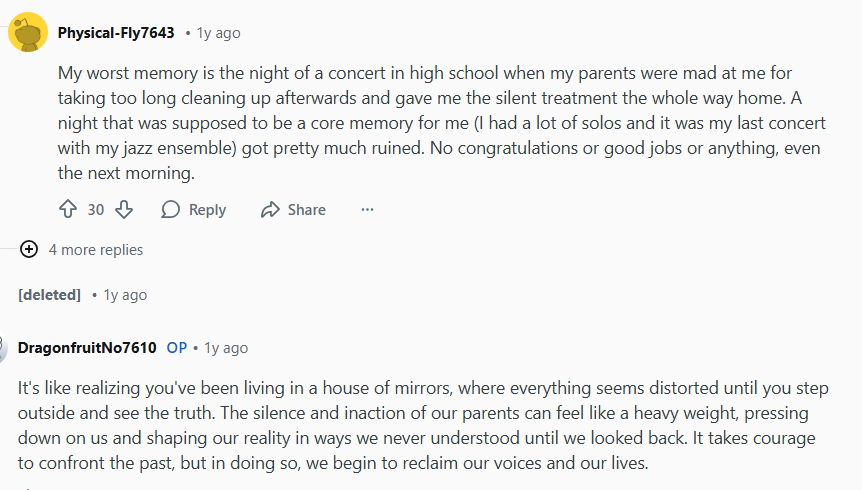
Please add here the attached screenshots as a gallery that I pasted with links at the end of the Blog.
Because your emotional needs were ignored, you might:
Work hard to make others happy — even when it hurts you.
Seek approval from partners, friends, or even strangers, hoping to feel “seen.”
Feel like love must come with conditions (success, perfection, obedience).
Struggle with boundaries — either never setting any or building walls too high.
Understanding this doesn’t excuse their behaviour, but it helps you see the roots of your pain. And once you see the roots, you can start cutting the weeds out.
Reasons Narcissistic Parents Don’t Love Their Children
A renowned relationship expert and life coach,Jerry Wise, helped thousands of people for 45 years to break free from narcissistic and dysfunctional family dynamics. Also helped them reclaim their lives from toxic influences, says:
“Good parents celebrate their child's uniqueness. Provide a safe space for them to explore the world. However, in the children of narcissist parents, this cherished bond is absent, replaced by manipulation, control and conditional affection. They only give affection when children meet their expectations.”
In short, Narcissistic parents don’t love their children in a healthy way because they lack empathy, see their children as extensions of themselves, and prioritize their own needs over the child’s.
Their love becomes conditional — based on obedience, performance, or how the child makes them look. They just use their children for validation, control, or ego-boosting rather than forming a genuine emotional bond.
On Pep Talk, where experts share their stories and tell how they escaped the life they didn’t want. Gamal 'G' Turawa, a survivor of physical child abuse, tells how he escaped his father’s beatings and ran away from home.
Does Broken Childhood Shape Your Adult Life? Why It Hurts So Deeply
Growing up feeling unloved by a parent leaves a unique kind of hurt. The hurt from a difficult childhood doesn't just live in the past. It follows you in your adult life, where you always think of yourself as “I’m the problem.”
Here are the reasons why the pain sticks around and how it shapes your adult life trauma.
1- Your First Mirror Was Broken
From the moment we’re born, we look to our parents like mirrors. Their faces are the first place we learn who we are.
When you have a narcissistic or abusive parent, that mirror is cracked. It reflects a distorted image: you are a problem, a burden, or simply invisible. As Elizabeth Shaw says:
“The mind games. Narcissists manipulate, guilt, project, gaslight and outright lie to you. They convince you that you are the crazy one.''
2- The Emotional Pain Confuses You
With a physical wound, you know what happened. But this pain is different. There are no clear scars for others to see. You might have had food on the table and a roof over your head, so you tell yourself, "It wasn't that bad. I should be over it."
But you're grieving something invisible. The loss of a basic security that every child deserves. You're grieving for the parent you needed but never had. Your confusing feelings and immense pain may not be understood by others. You can be doubtful of your own reality and experience emotional hurt.
3- Your Brain Is Wired for a War Zone
Home is supposed to be a safe ground where your brain does not stay on high alert. But if you somehow learned to stay on high alert, that’s not a good sign. The indications are:
You become a people-pleaser.
You became an expert in reading a room and managing another person's moods.
You struggle to trust anyone, because the people who were supposed to love you most couldn't be trusted.
You become fiercely hard on yourself because your inner critic is just the voice of your parent, now living in your head.
This isn't a flaw—it's the armour you built to survive.
This isn't a character flaw. It's the armour you built to survive your childhood trauma, and it becomes heavy to wear in a world that is no longer at war.
4- You Feel Shaky, Even When Things Are Good
A parent's love is the foundation for your life. When that foundation is cracked, everything feels shaky.
You might struggle to make decisions.
You could feel like an "imposter" at work or in relationships.
You find it hard to feel truly secure, even when you're safe.
Understanding these patterns is the first step to changing them. You can build a new, solid foundation for yourself.
The past shaped you, but it doesn't have to define your future.
“Why do I keep going back to the parents who hurt me?”
If you are asking yourself, “Why do I keep going back to the parents who hurt me?” Just know… It's a natural human response to bad treatment.
Deep down, a part of us still hopes that maybe, this time, they’ll be the parent we needed. Sometimes, the cycle of hurt feels so familiar that it almost seems normal. But most of us keep trying because every human being has a fundamental need to be seen, heard, and loved by their parents.
Wishing for love and then healing from parents' abuse, this isn't about quick fixes. It's a journey of rebuilding.
Healing Steps — How to Escape Abusive Parents
Recovery doesn’t happen overnight. But with small steps, healing becomes possible. Here are the baby steps that psychologists, therapists, and survivors suggest to start that journey.
1- You Have to Realize It’s Abuse
Before we go further, let's be clear about one thing: what you experienced was abuse.
Any kind of neglect or mistreatment from a parent damages your self-worth. This damage doesn't just fade; it's a deep wound that takes time and care to heal.
The tricky part is that this kind of abuse is usually hard to see from the outside. Your parent might have been a master at wearing a mask for the rest of the world. Behind closed doors, they used tactics to make you doubt your own memories and blame-shifting to convince you that you were the problem.
If you tried to tell someone, you might have been met with disbelief. Maybe you were told to "respect your parents" or that you were being dramatic. People who haven't lived through it can't understand why you wouldn't just walk away.
But you must trust your gut feeling. If you are constantly feeling small, controlled, silenced, or worthless, that is abuse. Your pain is real, and acknowledging that is the first and bravest step toward taking your power back.
2- Let Go of the Hope That They’ll Change
It is a fact that narcissistic parents don’t — or can’t — change. Clinging to hope for their “awakening” makes healing much harder. It’s okay to accept that they cannot give you what you need. That acceptance doesn’t make you cruel. It makes you wise.
3- Listen to Your Body’s Warning Signs
Your body knows the truth before your mind accepts it. The next time you interact with your parents, don't ignore the physical feelings.
Notice the tension in your shoulders, the knot in your stomach, or the heavy feeling in your chest. That is your body telling you, "This is painful."
Use that feeling as a cue. When you feel the urge to call them and seek their approval. Just pause… take a deep breath. Instead of reaching out, call a supportive friend, take a walk, read a book, or do something calming.
Believe me, you’ll break the cycle.
4- Set Boundaries. It’s Self-Love, Not Betrayal
Boundaries give your wounded inner child space to breathe again. Say “no” when you need to. It’s not disloyal — it’s survival. As one survivor said:
“Breaking free wasn’t about hate; it was about protecting hope for a better future.”
5- Find Support. You Don’t Have to Do This Alone
Loneliness deepens the hurt. Talking to people who understand — friends, support groups, therapists — helps you realize you’re not broken, just wounded. Research finds that survivors who connect with others heal better because sharing experiences lessens their pain.
6- Reparent Yourself — Nourish Your Inner Child
You never got a proper childhood. So now, give yourself one.
Treat yourself like a child you need to protect: be patient, kind, and gentle.
Do small things that bring joy — hobbies, walks, creativity, healthy habits.
This could be as simple as letting yourself play, setting a consistent bedtime, or speaking to yourself with encouragement.
Celebrate small wins. Healing isn’t a finish line — it’s a path.
Healing Is Real, Even After Years of Pain; It’s Possible
If you still doubt whether it’s worth trying, let these words make you hope again. One person on Reddit wrote after years of pain:
“My mother was a narcissist. She could be charming and kind one moment — and cold, cruel, or dismissive the next. “
She further says, after choosing to leave the past behind:
“I’m 45 now. I trust myself. I enjoy life. I don’t look back. Healing isn’t fast — but it’s real. I finally realized — their inability to love me wasn’t my fault.”Reddit
You may carry scars. But scars mean survival. You may have doubts. But doubts mean you’re thinking, questioning, wanting better. And wanting better is the first step toward a new, peaceful life.




.svg)